QUANTA

Friday, January 3, 2014

15 Tech Predictions for 2014

No matter how you look at it, making predictions is risky business and making technology predictions is riskier still. It’s almost as silly as shooting darts at Jell-O – hitting the target is downright impossible.
Between the uncertainty over killer apps, the unpredictability of innovation, and hot new companies that can change competitive landscapes overnight, there are so many variables you’ve got to be crazy to risk making calls over a time horizon as short as a year.
Well, call me crazy, but here are 7 things that, according to my crystal ball, will happen in 2014 – plus 8 more predictions in the lightning round.
A killer app will emerge in wearable computing. It’s probably more likely to come from Apple’s long-rumored iWatch than Google Glass or any other device for the simple reason that Apple has an insane track record of creating category-killing devices. As for the app itself, I’m willing to bet that it’s something you can already do on other devices, except now it’ll be completely hands-free.
A killer app will not emerge in 3D printing. While 3D printing technology is beginning to look interesting, it’s still in what I would characterize as an enthusiast phase. That said, personal computing and gaming started out more or less the same way. Still, if you’re going to fire a live round from a gun you printed, just remember, arm’s length is not a very safe distance from an exploding projectile.
Millions will lose their wallets. Apple has more credit cards on file than any other company on Earth, courtesy of iTunes, and for years it’s been filing all sorts of patent applications for a digital wallet service called iMoney. I think there’s a 50-50 chance the new service will launch this year, either with iWatch or iPhone 6. Don’t leave home without it.
There will be IPOs – lots of IPOs. While the IPO market took a dive following the dot-com bust, we’ve seen that trend reverse in recent years. In terms of proceeds and number of deals, 2013 was the best year for U.S. IPOs since 2000. Data from CB Insights suggests the tech IPO pipeline for 2014 may be even stronger than 2013 with Alibaba, Square, Box, Dropbox, Coupons.com, Lending Club, Pivotal, and GrubHub Seamless rumored to be in the mix.
Nobody will conquer the living room. For what seems an eternity, the broadcast, media, cable, and technology powers-that-be have waged an all-out war for control of the living room, leaving consumers as collateral damage. Whether Apple or anyone else can pull off a seamless integration of this fragmented mess is anyone’s guess but I wouldn’t hold my breath for 12 months, if I were you.
Microsoft will hire a new CEO. Yes, I’m well aware of the 100% certainty of that statement. But whether the software giant’s board brings in an outsider such as Alan Mulally (my choice) or promotes an insider like Satya Nadella, we won’t know if it was a good choice for years to come. And, as I’ve said time and again, the task of reinventing a company that big, that complex, and that competes in so many different markets, is incredibly challenging.    
Time travel will become a reality. Amazon will create an ecommerce service with drones equipped with tachyon drives that will allow them to go faster than the speed of light. In other words, you’ll actually receive your packages before you order them. (Yes, that was, in fact, a joke.)
In case you can’t get enough of this sort of thing, here is a lightning round of eight more tech predictions, some of which fly in the face of what other commentators are putting out there:
Somebody will create an app that will tell you with 100% certainty when a politician is lying – because his lips will be moving (wait, you heard that one before?).
There will be no real, legitimate backlash over privacy concerns. As Sun Microsystems chief executive Scott McNealy famously and correctly said nearly 15 years ago, “You have zero privacy anyway. Get over it.”
Google will not overtake Apple to become the most valuable technology company on Earth – at least not yet – but the search advertising giant will continue to bring you ads on any device, on any application, wherever you are, and whatever you’re doing.
While interim CEO John Chen was a good choice, and he may very well help the company survive on enterprise services, BlackBerry will not rise from the dead as a smartphone powerhouse.
Twitter will not become less annoying and people will not stop doing anything they can to gain more followers ... for no legitimate or logical reason.
The Internet of Things won’t change your life. While it is very cool stuff that will affect us all in many ways, smart cities, smart highways, and smart grids are industrial things that happen very, very slowly. Like the Earth’s rotation, you won’t notice a thing.
Just as with weight loss systems, diets, and pills, more and more people will spend more and more money on fitness devices like Fitbit and Fuelband and still, remarkably, continue to become more obese and less healthy.
It will slowly begin to dawn on consumers and the auto industry that range anxiety and having to plug an electric car into a socket is incredibly dumb and a giant leap backwards from hybrid technology where the car actually charges its batteries itself. I’m just saying.
Steve Tobak is a Silicon Valley-based strategy consultant and former senior executive of the technology industry.


(¯`*• Global Source and/or more resources at http://goo.gl/zvSV7 │ www.Future-Observatory.blogspot.com and on LinkeIn Group's "Becoming Aware of the Futures" at http://goo.gl/8qKBbK │ @SciCzar │ Point of Contact: www.linkedin.com/in/AndresAgostini

Cloud computing 2014: Moving to a zero-trust security model

Snowden leaks aren't driving companies away from the cloud; but the disclosures have made them a lot more careful

December 31, 2013 06:45 AM ET
Computerworld - The leaking of classified documents detailing the data collection activities of the U.S. National Security Agency earlier this year reignited some long-standing concerns about the vulnerability of enterprise data stored in the cloud.
But instead of scaring businesses away from using hosted services, as some experts predicted, the leaks about the NSA spy programs are driving some long overdue changes in enterprise and service provider security and privacy policies.
When Edward Snowden first began spilling details of the NSA's surveillance practices to selected reporters in June, industry analysts had expected that the revelations would put a severe crimp on plans for cloud deployment.
For instance, the Information Technology & Innovation Foundation in August said the leaks could cause U.S. cloud providers to lose 10% to 20% of the foreign market to overseas competitors -- or up to $35 billion in potential sales through 2016.
Another industry group, the Cloud Security Alliance, predicted a similar backlash due to concerns by Europen companies that thje U.S. government would access to their data.
Six months later, the impact appears to be less severe than expected.
Despite some reports of slowing sales of cloud services by U.S. vendors to overseas companies, experts now expect that the Snowden leaks will have little effect on long-term sales. The business benefits of using cloud-based services continue to supersede enterprise fears of government snooping.
At the same time though, the detailing of classified NSA spy programs has prompted an increased emphasis on cloud data security and protection that's expected to grow further in 2014.
The leaks hammered home just how little control companies have over data stored in the cloud, said Richard Stiennon, principal at consulting firm IT-Harvest. "There is a fundamental shift to a zero-trust model in the cloud." The disclosures showed enterprises that "there cannot be any chink in the trust chain from internal resources to the cloud and back."
Analysys say IT security officials are looking at several key areas, such as data encryption, key management and data ownership, regionalization, and the need for increased government transparency, to improve cloud security.

Data encryption

Encryption has gained a lot of attention since the Snowden leaks. Major service providers like Microsoft, Yahoo and Google set the tone by adding end-to-end encryption of data they host and manage for customers.
For instance, Google Cloud Storage now automatically encrypts all new data before it's written to disk. Such server-side encryption will soon be available for older data stored in Google clouds.
Since the NSA programs were disclosed, Microsoft has announced that it plans to ramp up encryption support for various services, including Outlook.com, Office 365, SkyDrive and Windows Azure.
By the end of 2014, Microsoft expects to have measures in place for encrypting data in transit between customer locations and its data centers, and while in transit between its own data centers.
Like Google, Microsoft says it plans to encrypt all stored data in the cloud
Several other cloud services providers, like Dropbox, Sonic.net and SpiderOak, have announced support for similar data encryption programs, and for features like 2048-bit key lengths and the "Perfect Forward Secrecy" method for future-proofing encrypted data.
Experts say such measures are vital to protecting data traveling between customer companies and cloud service providers.
Information in the classified documents about NSA attempts to weaken encryption algorithms, and to tap fiber links connecting service provider data centers provided much of the impetus for these efforts.

Key management and data ownership

The U.S. government's position in its dispute with Lavabit, a secure email services provider, that cloud service firms must hand over their encryption keys when asked, has focused considerable attention on key management and data ownership.
While encryption efforts by service providers are a vital part of improving cloud security, they only go so far, says Eric Chiu, president of HyTrust, a cloud infrastructure management company.


(¯`*• Global Source and/or more resources at http://goo.gl/zvSV7 │ www.Future-Observatory.blogspot.com and on LinkeIn Group's "Becoming Aware of the Futures" at http://goo.gl/8qKBbK │ @SciCzar │ Point of Contact: www.linkedin.com/in/AndresAgostini

Best of 2013: US Military Scientists Solve the Fundamental Problem of Viral Marketing

In September, network theorists working for the US military worked out how to identify the small “seed” group of people who can spread a message across an entire network

Viral messages begin life by infecting a few individuals and then start to spread across a network. The most infectious end up contaminating more or less everybody.
Just how and why this happens is the subject of much study and debate. Network scientists know that key factors are the rate at which people become infected, the “connectedness” of the network and how the seed group of individuals, who first become infected, are linked to the rest.
It is this seed group that fascinates everybody from marketers wanting to sell Viagra to epidemiologists wanting to study the spread of HIV.
So a way of finding seed groups in a given social network would surely be a useful trick, not to mention a valuable one. Step forward Paulo Shakarian, Sean Eyre and Damon Paulo from the West Point Network Science Center at the US Military Academy in West Point.
These guys have found a way to identify a seed group that, when infected, can spread a message across an entire network. And they say it can be done quickly and easily, even on relatively large networks.
Continue reading…


(¯`*• Global Source and/or more resources at http://goo.gl/zvSV7 │ www.Future-Observatory.blogspot.com and on LinkeIn Group's "Becoming Aware of the Futures" at http://goo.gl/8qKBbK │ @SciCzar │ Point of Contact: www.linkedin.com/in/AndresAgostini

Surveillance network built to spot secret nuclear tests yields surprise scientific boon

Video: Undersea acoustic monitors set up to detect illegal nuclear activity pick up all sorts of other sounds as well, ranging from whales to earthquakes.
VIENNA — It records sounds that no human ear can hear, like the low roar of a meteor slicing through the upper atmosphere, or the hum an iceberg makes when smacked by an ocean wave.
It has picked up threats invisible to the human eye, such as the haze of radioactive particles that circled the planet after the Fukushima nuclear accident in Japan in 2011.

NSA seeks quantum computer that could crack most codes

Documents provided by Snowden show race for a machine light-years ahead of those using zeroes and ones.

Syria blamed for missed deadline on chemical arsenal

Syria blamed for missed deadline on chemical arsenal
U.S. officials cite Syrian foot-dragging as deadline nears for removing chemical weapons stockpile.

Global surveillance network yields surprising science boon

A planetary monitoring system meant to spot nuclear explosions helps scientists track natural disasters.

Snowden, in interview, says his mission’s accomplished

Snowden, in interview, says his mission’s accomplished
His leaks have fundamentally altered the U.S. government’s relationship with its citizens, the rest of the world.

Full coverage: NSA Secrets

Full coverage: NSA Secrets
Read all of the stories in The Washington Post’s ongoing coverage of the National Security Agency’s surveillance programs.
Click here to subscribe.
The engineers who designed the world’s first truly planetary surveillance network two decades ago envisioned it as a way to detect illegal nuclear weapons tests. Today, the nearly completed International Monitoring System is proving adept at tasks its inventors never imagined. The system’s scores of listening stations continuously eavesdrop on Earth itself, offering clues about man-made and natural disasters as well as a window into some of nature’s most mysterious processes.
The Obama administration hopes the network’s capabilities will persuade a reluctant Senate to approve a nuclear test-ban treaty that stalled in Congress more than a decade ago. Meanwhile, without the treaty and wholly without fanfare, new stations come on line almost every month.
“We can pick up whale sounds, and ice sheets cracking,” said Thomas Muetzelburg, a spokesman for the Comprehensive Nuclear Test-Ban Treaty Organization (CTBTO), the Vienna-based group that operates the network. More importantly, he said, “we can reliably detect nuclear tests.”
The monitoring system is a latticework of sensors — including radiation detectors and machines that measure seismic activity or low-frequency sound waves — spread out across 89 countries as well as the oceans and polar regions. Like a giant stethoscope, it listens for irregularities in Earth’s natural rhythms, collecting and transmitting terabytes of data to a small office in the Austrian capital.
The network was designed to help enforce the 1996 Comprehensive Nuclear Test-Ban Treaty, which outlawed explosive testing of nuclear weapons. But while the treaty has never entered into force — the United States and seven other countries have declined to ratify it, in part because of concerns over verification — the monitoring network has steadily grown over the years, from a handful of stations in 2003 to more than 270.
The network has emerged as one of the most compelling arguments for the treaty, advocates say. Arms-control officials in the Obama administration have cited the network’s advances in arguing for a new push for Senate ratification of the nuclear test ban, despite opposition from prominent Republicans who argue that the pact undermines U.S. interests.
“There has been a growing realization, especially after Fukushima, that the International Monitoring System has improved to an impressive level,” Rose Gottemoeller, the State Department’s assistant secretary for arms control, verification and compliance, said in an interview. “It became clear that the time is right to go out and talk about these accomplishments and what the treaty can do for U.S. national security.”
The test-ban treaty has not come up for a vote in the Senate since 1999, when it was soundly defeated. The vote embarrassed the Clinton administration and drew criticism from countries around the world, including Russia, which is among the pact’s 161 signatories.
At the time, the United States had already halted testing of its nuclear weapons under an undeclared moratorium that began in 1992. Still, most Republicans and many Democrats opposed the treaty on the grounds that it offered false security; at the time, there was no global system in place that could reliably detect cheating.
The International Monitoring System was designed to address those concerns. Construction began on the first listening stations in 2000, and dozens were operating by 2006, when the network experienced its first major test — an underground detonation that signaled North Korea’s emergence as a nuclear weapons power. The country’s communist government would conduct two additional nuclear tests, in 2009 and last February.
“We detected the announced 2006 test even though only 60 percent of the network was in place,” said Muetzelburg, the ­CTBTO official. He said 21 of the system’s stations registered that event, compared with 94 seismology stations detecting North Korea’s test in 2013.
As it turned out, the network’s listening posts did more than simply pick up the tests’ underground shock waves. Numerous stations also picked up trace amounts of radioactive xenon, a gas emitted in nuclear explosions. From studying the xenon plume, scientists could even calculate how long North Korea waited to open the sealed entrances to its underground test chambers.
Arms-control experts say the North Korean tests show that the monitoring system is up to the challenge for which it was designed — deterring secret nuclear weapons tests. While today’s advanced computers can conduct simulations of a nuclear explosion, few countries would seek to field a nuclear arsenal — or modernize an existing one — without testing whether the technology works, according to a senior European diplomat involved in arms-control negotiations.
“This actually works in the favor of the United States, because it effectively freezes its nuclear advantages in place while inhibiting other countries from developing nuclear weapons,” said the official, who insisted on anonymity because he was not authorized to discuss the matter.
Arms-control advocates worry that a failure to approve the treaty will eventually result in increased competition among countries seeking to acquire nuclear weapons or upgrade their arsenals. If all hope for passage dies, support for the monitoring network — which costs more than $120 million annually in member-state dues to maintain — will probably dry up as well, proponents say, leading to the loss of a scientific asset with benefits to the entire planet.
In the past two years alone, advocates note, the network has contributed to scientists’ understanding of a variety of natural disturbances. When a deadly tsunami damaged Japan’s Fukushima nuclear reactor, the network’s sensors tracked the spread of airborne radioactive contamination across the Pacific Ocean to North America and beyond. And last year, when an asteroid exploded over Russia’s Chelyabinsk province, the system’s monitors were able to track the trajectory and size of the space rock as it plummeted toward Earth.
Current and former U.S. officials who have followed the network’s evolution say its capabilities are impressive, but they acknowledge that it may not be enough to sway doubters in Congress. While President Obama has promised to push for ratification of the test-ban treaty, former lawmakers say the public support necessary to win passage has not materialized.
“It looks pretty far away at this moment,” said former senator Richard G. Lugar (R-Ind.), a champion of arms control during his three decades in Congress who opposed the test-ban treaty in 1999, in part because of concerns over verification. “Just getting the START treaty across the finish line was such a struggle, and it was relatively modest.”
Gottemoeller, the State Department official, noted that support for the 1960s ban on aboveground nuclear tests was prompted by a global concern about radioactive contaminants in milk. “The Limited Test Ban Treaty grew out of a mother’s movement,” she said. “We need to generate that kind of public support.”

(¯`*• Global Source and/or more resources at http://goo.gl/zvSV7 │ www.Future-Observatory.blogspot.com and on LinkeIn Group's "Becoming Aware of the Futures" at http://goo.gl/8qKBbK │ @SciCzar │ Point of Contact: www.linkedin.com/in/AndresAgostini

The Faster a New Technology Takes Off, the Harder It Falls

  • By Larry Downes and Paul Nunes
  • 6:30 AM
Image: mjaniec/Flickr
First, a eulogy: The bell curve is dead.
That familiar model for technology adoption (first popularized by the noted sociologist Everett Rogers) — with clearly defined market segments adopting new technologies in predictable groupings — no longer applies. Following this work, Geoffrey Moore wrote in 1991’s Crossing the Chasm that successful new product introductions followed Rogers’s five discrete stages, moving from early adopters to mainstream users only after crossing a sales “chasm” in which the marketing message changes from the new and exciting to the familiar and incremental.
But today, new products and services enter the market better and cheaper right from the start. So producers can’t rely on a class of early adopters and high margins to build up a war chest to spend on marketing to larger and later markets. For better and for worse, thanks to near-perfect market information, consumers are too savvy for that. Everyone knows right away when some new offering gets it right — or, conversely, gets it wrong.
The bell curve, once useful as a model of product adoption, has lost its value as a planning tool. This kind of disruption has its own unique life cycle, and with it its own best practices for marketing and sales, product enhancement, and eventual product replacement.

Markets take off suddenly, or they don’t take off at all. Since adoption is increasingly all-at-once or never, saturation is reached much sooner in the life of a successful new product. So even those who launch these “Big Bang Disruptors” — new products and services that enter the market better and cheaper than established products seemingly overnight — need to prepare to scale down just as quickly as they scaled up, ready with their next disruptor (or to exit the market and take their assets to another industry).
While every Big Bang Disruptor has its own unique trajectory, the examples in our study suggest a new model for the adoption of better and cheaper innovations, one that is radically different from the traditional view of and Rogers and Geoffrey Moore. The life cycle of Big Bang Disruption looks less like a gently sloping bell curve and more like a cliff: as dangerous to competitors on its way up as it is to innovators on the way down.

We call it, for obvious reasons, “the shark fin.”
The process of Big Bang Disruption begins as a series of low-level, often unrelated experiments with different combinations of component technologies. This relative calm may give incumbents the false sense that nothing is happening, or in any event that whatever might be happening is not doing so quickly enough to warrant a competitive response.
Yet when the right combination of technologies is assembled and paired with the right business model, takeoff is immediate. Customers from a wide range of segments, including mass market consumers, adopt the disruptor as quickly as its producers can supply it. Market penetration is often nearly instantaneous.
Next, as the disruptor quickly approaches saturation, adoption drops at nearly the same pace with which it took off, leading to a period of rapid if uneven decline. During this period, early warning systems, careful planning, and the agility to quickly scale up and then down are essential both to capitalize on the opportunity of a Big Bang Disruptor as well as to survive the chaos it can bring to existing markets.

The Rise and Fall of Microsoft’s Kinect

One example of this process was the introduction of an add-on device for Microsoft’s Xbox 360: the Kinect. It initially sold for $150, but it revolutionized home gaming — capturing the imagination of diehard players and casual gamers alike. And while it appeared to come out of nowhere, antecedents could be seen in and out of the gaming industry. Integrating motion and other sensors with facial recognition, for example, had long been in development in many industries, especially in security systems.
Speech recognition, likewise, had already been used in products and services supporting hands-free computing tasks such as automated phone support and in applications including GM’s in-vehicle OnStar system and the popular Siri, which Apple acquired in 2010. Facial recognition had been used for high-end military applications for years and was the subject of extensive experiments by the advertising industry.
Even other game consoles, notably Sony’s PlayStation 3, had experimented with handheld controllers fitted with motion sensors. Sony’s add-on device, the Move, sold fifteen million units in its first two years.
No one, however, had ever put all these components together or integrated them with a catalog of new games designed specifically to take advantage of the powerful hardware and software Microsoft used for Kinect. The new device looked less like its predecessors than it did a technology from the future.
Kinect was an enormous hit, selling eight million units in just the first sixty days. According to Guinness World Records, that made Kinect the fastest-selling consumer electronic device in history. A little over a year after launch, twenty-four million Kinects had been sold, pushing sales of Xbox 360 consoles and games along with it. In 2010, Microsoft took the top spot in the fiercely competitive console market for the first time since Xbox 360’s launch in 2001.
For Big Bang Disruptors, however, catastrophic success invariably leads to rapid market saturation — and with it decline and sunset. Within six months, the pace of Kinect sales dropped precipitously. Though stragglers continued to buy the product in peaks and valleys over the next year, the product had largely fulfilled its mission in its first ten months. For Microsoft — and other game developers — it was time for another innovation.

Big Bang Disruptors like the Kinect, however, can have second lives as new innovators deconstruct them and recombine their parts into something new. Kinect continues to find unexpected uses outside of gaming, thanks in part to Microsoft’s willingness to make its developer tools and interfaces widely available. Telemedicine researchers in the UK, for example, have adapted Kinect for remote tracking of hand and finger movements to guide patients recovering from strokes. Kinect’s technology is also being used in the construction of miniature satellites, where Kinect will handle in-orbit docking.

Farther afield, the economies of scale that comes from production of millions of Kinect units has made it cost-effective to use some of its components for a fast-evolving market of health, fitness, and monitoring devices. Companies including Fitbit, Jawbone, and Nike, as well as other startups, are selling low-cost wearable computers that use accelerometers and other sensor technology to track and record an increasingly wide range of vital signs and measurements, including steps taken, calories burned, heart rate, temperature, and sleep patterns.
With the shark fin, companies that have long operated as the flippers of their industry, controlling its speed, direction, and destination, suddenly find themselves the pinball, bouncing around at the whim of forces outside their control. To ensure their future as the former and not the latter, they need to understand where Big Bang Disruptors come from, how they enter and exit the market, and what they leave in their wake.
This is the first book selected for the inaugural Book Club at CES, as their book of the year. It will be released January 7. 
Excerpted from Big Bang Disruption: Strategy in the Age of Devastating Innovation by Larry Downes and Paul Nunes, in agreement with Portfolio, an imprint of Penguin Random House. Copyright 2014 by Lawrence Downes and Paul Nunes.


(¯`*• Global Source and/or more resources at http://goo.gl/zvSV7 │ www.Future-Observatory.blogspot.com and on LinkeIn Group's "Becoming Aware of the Futures" at http://goo.gl/8qKBbK │ @SciCzar │ Point of Contact: www.linkedin.com/in/AndresAgostini

Taking On Trash By Converting Plastic To Currency

In Peru, one entrepreneur is giving a reason for citizens to pick up litter: They can get useful items, services, and even 3-D print their own parts from plastic in return.
Go to many beaches in the developing world and you'll see the same thing: piles of plastic garbage on the sand or in the water. Plastic pollution is a global problem, and an intractable one. People rely on plastic because it's cheap. But none of it decomposes, and, often there's no formal recycling service.
Vancouver entrepreneur David Katz's solution: Give people incentives to collect garbage by creating value from the waste. In other words, make plastic pollution a "currency." Katz's organization, Plastic Bank, has a plan to set up recycling facilities in poorer countries, where locals can exchange plastic for a range of useful items and services.
"If we can reveal the value in the things around us, then we can give people the opportunity to make a better life with that," he says.
Katz runs a successful GPS tracking business, but he's long been horrified by plastic pollution and wanted to do something about it. He came up with the Plastic Bank after attending a meeting at the Singularity University in California, where he met Lorenzo Sousa, the founder of the railway company PeruRail. The businessmen plan to open the first Plastic Bank facility in Peru next April.
Pickers will be able to exchange mixed plastics for shoes, food, and other basic goods, and even use 3-D printing facilities to make their own items or parts. "Perhaps they're working with waste from a gas station and the mechanics need components they can print on site. It gives them an opportunity to take the waste out of the environment and make something worth $5, $10, or $20," Katz says.

The center will also offer training, so waste collectors can scale up their entrepreneurship and maybe create their own recycling facilities.
Katz says that a "major corporation" has agreed to take the plastic and create new products from it. He won't reveal the name of the company, but says it can see marketing value in the concept. "Knowing that the plastic came from a waterway and that it helps people out of poverty through its collection and reuse--that's a strong story."
After Peru, Katz wants to go other countries like Columbia, the Philippines, and Indonesia. He's looking for local partners now. "I don't have every answer yet. But I know it's something that has to be begun at least," he says. "If I begin it, I'll find the answers, and, most importantly, I'll reveal the questions I need to answer."

(¯`*• Global Source and/or more resources at http://goo.gl/zvSV7 │ www.Future-Observatory.blogspot.com and on LinkeIn Group's "Becoming Aware of the Futures" at http://goo.gl/8qKBbK │ @SciCzar │ Point of Contact: www.linkedin.com/in/AndresAgostini

These Scientists Studied Why Internet Stories Go Viral. You Won't Believe What They Found

Science confirms what Buzzfeed and Upworthy already know: In the hierarchy of digital contagion, content that evokes powerful emotions floats mercilessly to the top.
A few weeks ago, the Wall Street Journal profiled Gawker editor Neetzan Zimmerman, whose job is to post content that's poised to go viral. Zimmerman does his job quite well. His posts generate about 30 million pageviews a month--tops at the site by far, six times what the second-leading staffer generates. Zimmerman's success is not the result of some computer formula; on the contrary, rather, "he understands the emotions that might compel a human being to click on something online," the Journal's Farhad Manjoo writes.
If the traffic numbers don't already show the wisdom of Zimmerman's approach, the behavioral evidence certainly does. Recent research suggests that emotions hold the secret to viral web content. Articles, posts, or videos that evoke positive emotions have greater viral potential than something that evokes negative feelings, but both do a better job recruiting clicks than neutral content. The finer details tell a similar story: triggering high-arousal emotions, such as anger or humor, is a surer path to click gold than triggering low-arousal ones, such as contentment or sadness.

Take a recent a study published in the November issue of Computers in Human Behavior. A research team led by Rosanna E. Guadagno of the National Science Foundation showed 256 test participants one video from a collection that spanned the emotional spectrum. Some saw a cute or funny clip that had gone viral on YouTube. Others saw a hit that evoked anger or disgust. Still others saw a neutral video about basket-weaving.
After the viewing, participants were asked whether or not they would share that video with someone else. Those who'd seen the funny or cute video were significantly more likely to say they'd forward it than any of the other test participants. Those who'd seen the video causing anger or disgust were significantly more likely to say the same than those who'd seen the neutral clip. A follow-up test with 163 more participants found the same pattern of viral potential: positive emotions best negative ones, any emotion bests none at all.
Part of what makes emotional content so susceptible to spreading is that emotions themselves are contagious. Researchers have long known that people can "catch" the emotions of someone around them, so to speak, through direct exposure to that person's expressions and tones and gestures. They also believe this process of emotional contagion can occur indirectly--say, by receiving a forwarded video clip or article.
The physiological arousal produced by certain emotions may also help explain why some web content goes viral and some doesn't. A few years ago, Wharton behavioral scholars Jonah Berger and Katherine Milkman analyzed roughly 7,000 articles that appeared on the New York Times website to see which ones made the "most emailed" list. After controlling for factors like page prominence and author fame, the researchers found that emotional content indeed went viral more often than non-emotional pieces.

But Berger and Milkman didn't stop their analysis there. Within the emotional articles, they recognized that content evoking high-arousal emotions (in this case, awe, anger, and anxiety, emotions that tend to whip us into action) went viral more often than articles evoking a low-arousal emotion (sadness, an emotion that often leaves us subdued). The odds that an article would end up on the "most emailed" list increased 34% when it elicited one standard deviation more anger, the equivalent of letting the article spend an extra 3 hours as the lead story on the Times website.
Berger, author of the 2013 book Contagious: Why Things Catch On, extended this finding even further during a separate laboratory study. He asked some test participants to sit still before reading a neutral article, and asked others to jog in place for a minute before reading the same piece. Then he gave both groups the option of emailing the article to someone else. Three-quarters of the joggers forwarded it against only a third of the sitters--a further sign, in Berger's eyes, that arousal plays a major role in social transmission.
"More arousing content should be more likely to spread quickly on the Internet and should be more likely to capture public attention," he concluded in Psychological Science.
Knowing that emotional arousal contributes to digital contagion should help designers and other creative types craft catchier content (if that's their goal). Public officials might take note, too, especially as they try to distribute information through service announcements that tend to be dry by nature. A public health spot that evokes sadness, for instance, may be less likely to make the rounds than something that causes angst or indignation--though both should be more effective than something safe.

Then again, many factors influence whether or not something goes viral. Interesting content is a must, and catching the eye of a major Twitter personality can't hurt. A heavy marketing push can also boost a video's exposure; (in fact, one of Neetzan Zimmerman's biggest fears, according to the Journal, is that advertisers will co-opt viral news). And, of course, there's the difficulty in evoking strong feelings in the first place. It's one thing to understand the emotions that compel a person to click. It's another thing entirely to produce them.


(¯`*• Global Source and/or more resources at http://goo.gl/zvSV7 │ www.Future-Observatory.blogspot.com and on LinkeIn Group's "Becoming Aware of the Futures" at http://goo.gl/8qKBbK │ @SciCzar │ Point of Contact: www.linkedin.com/in/AndresAgostini

NSA seeks to develop quantum computer to crack nearly every kind of encryption

January 3, 2014
[+]
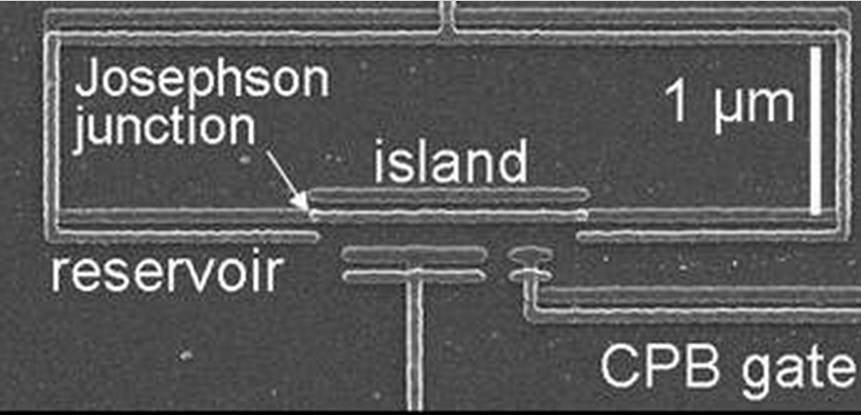
SEM micrograph of typical Cooper-pair device  (credit: Laboratory for Physical Sciences)
Is this device above — part of a quantum-computing research project at the Laboratory for Physical Sciences in Maryland — the core of a future NSA quantum computer for cracking nearly every kind of encryption used to protect banking, medical, business and government records around the world?
According to documents provided by former NSA contractor Edward Snowden, the effort to build “a cryptologically useful quantum computer” is part of a $79.7 million research program titled “Penetrating Hard Targets,” The Washington Post revealed Thursday.
Much of the work is hosted under classified contracts at this laboratory, the newspaper says. On its website, the lab mentions its work on quantum mechanical effects in superconducting circuits at a temperature of about 10 mK (barely above absolute zero), using a superconducting charge qubit or Cooper-pair box.
According to the Post, the NSA is expected to be able to have some building blocks by the end of September, which it described in a document as “dynamical decoupling and complete quantum ­control on two semiconductor qubits.”
Another project, called “Owning the Net,” aims at quantum-based attacks on encryptions, the Post says.
“The application of quantum technologies to encryption algorithms threatens to dramatically impact the US government’s ability to both protect its communications and eavesdrop on the communications of foreign governments,” the Post said, based on an internal document provided by Snowden.

(¯`*• Global Source and/or more resources at http://goo.gl/zvSV7 │ www.Future-Observatory.blogspot.com and on LinkeIn Group's "Becoming Aware of the Futures" at http://goo.gl/8qKBbK │ @SciCzar │ Point of Contact: www.linkedin.com/in/AndresAgostini

Turning off the ‘aging genes’

Computer algorithm developed by TAU researchers identifies genes that could be transformed to stop the aging process
January 3, 2014
[+]
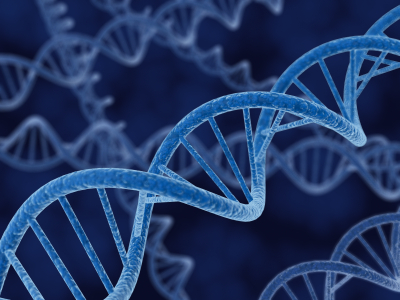
(Credit: iStock)
Tel Aviv University researchers have developed a computer algorithm that predicts which genes can be “turned off” to create the same anti-aging effect as calorie restriction*. The findings, reported in Nature Communications, could lead to the development of new drugs to treat aging.
“Most algorithms try to find drug targets that kill cells to treat cancer or bacterial infections,” says Keren Yizhak, a doctoral student in Prof. Eytan Ruppin’s laboratory. “Our algorithm is the first in our field to look for drug targets not to kill cells, but to transform them from a diseased state into a healthy one.”
Ruppin’s lab is a leader in the growing field of genome-scale metabolic modeling or GSMMs. Using mathematical equations and computers, GSMMs describe the metabolism, or life-sustaining, processes of living cells. Yizhak’s algorithm, which she calls a “metabolic transformation algorithm,” or MTA, can take information about any two metabolic states and predict the environmental or genetic changes required to go from one state to the other.
“Gene expression” is the measurement of the expression level of individual genes in a cell, and genes can be “turned off” in various ways to prevent them from being expressed in the cell. In the study, Yizhak applied MTA to the genetics of aging. After using her custom-designed MTA to confirm previous laboratory findings, she used it to predict genes that can be turned off to make the gene expression of old yeast look like that of young yeast. Yeast is the most widely used genetic model because much of its DNA is preserved in humans.
Some of the genes that the MTA identified were already known to extend the lifespan of yeast when turned off. Of the other genes she found, Yizhak sent seven to be tested at a Bar-Ilan University laboratory. Researchers there found that turning off two of the genes, GRE3 and ADH2, in actual (non-digital) yeast significantly extends the yeast’s lifespan.
“You would expect about three percent of yeast’s genes to be lifespan-extending,” said Yizhak. “So achieving a 10-fold increase over this expected frequency, as we did, is very encouraging.”
Hope for humans
Since MTA provides a systemic view of cell metabolism, it can also shed light on how the genes it identifies contribute to changes in genetic expression. In the case of GRE3 and ADH2, MTA showed that turning off the genes increased oxidative stress levels in yeast, thus possibly inducing a mild stress similar to that produced by calorie restriction.
As a final test, Yizhak applied MTA to human metabolic information. MTA was able to identify a set of genes that can transform 40 to 70 percent of the differences between the old and young information from four different studies. While currently there is no way to verify the results in humans, many of these genes are known to extend lifespan in yeast, worms, and mice.
Next, Yizhak will study whether turning off the genes predicted by MTA prolongs the lifespan of genetically engineered mice.
One day, drugs could be developed to target genes in humans, potentially allowing us to live longer. MTA could also be applied to finding drug targets for disorders where metabolism plays a role, including obesity, diabetes, neurodegenerative disorders, and cancer.
* Restricting calorie consumption is one of the few proven ways to combat aging. Though the underlying mechanism is unknown, calorie restriction has been shown to prolong lifespan in yeast, worms, flies, monkeys, and, in some studies, humans.

Abstract of Nature Communications paper
The growing availability of ‘omics’ data and high-quality in silico genome-scale metabolic models (GSMMs) provide a golden opportunity for the systematic identification of new metabolic drug targets. Extant GSMM-based methods aim at identifying drug targets that would kill the target cell, focusing on antibiotics or cancer treatments. However, normal human metabolism is altered in many diseases and the therapeutic goal is fundamentally different—to retrieve the healthy state. Here we present a generic metabolic transformation algorithm (MTA) addressing this issue. First, the prediction accuracy of MTA is comprehensively validated using data sets of known perturbations. Second, two predicted yeast lifespan-extending genes, GRE3 and ADH2, are experimentally validated, together with their associated hormetic effect. Third, we show that MTA predicts new drug targets for human ageing that are enriched with orthologs of known lifespan-extending genes and with genes downregulated following caloric restriction mimetic treatments. MTA offers a promising new approach for the identification of drug targets in metabolically related disorders.

(¯`*• Global Source and/or more resources at http://goo.gl/zvSV7 │ www.Future-Observatory.blogspot.com and on LinkeIn Group's "Becoming Aware of the Futures" at http://goo.gl/8qKBbK │ @SciCzar │ Point of Contact: www.linkedin.com/in/AndresAgostini

Fully self-driving cars expected by 2030, says forecast

New IHS Automotive study forecasts nearly 12 million yearly self-driving cars sales and almost 54 million in use on global highways by 2035
January 3, 2014
[+]Google_autonomous_vehicle
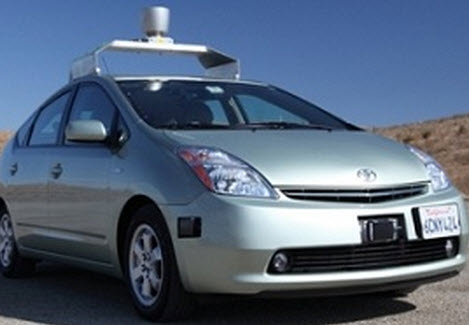
Fully self-driving cars are expected by 2030 (credit: Google)
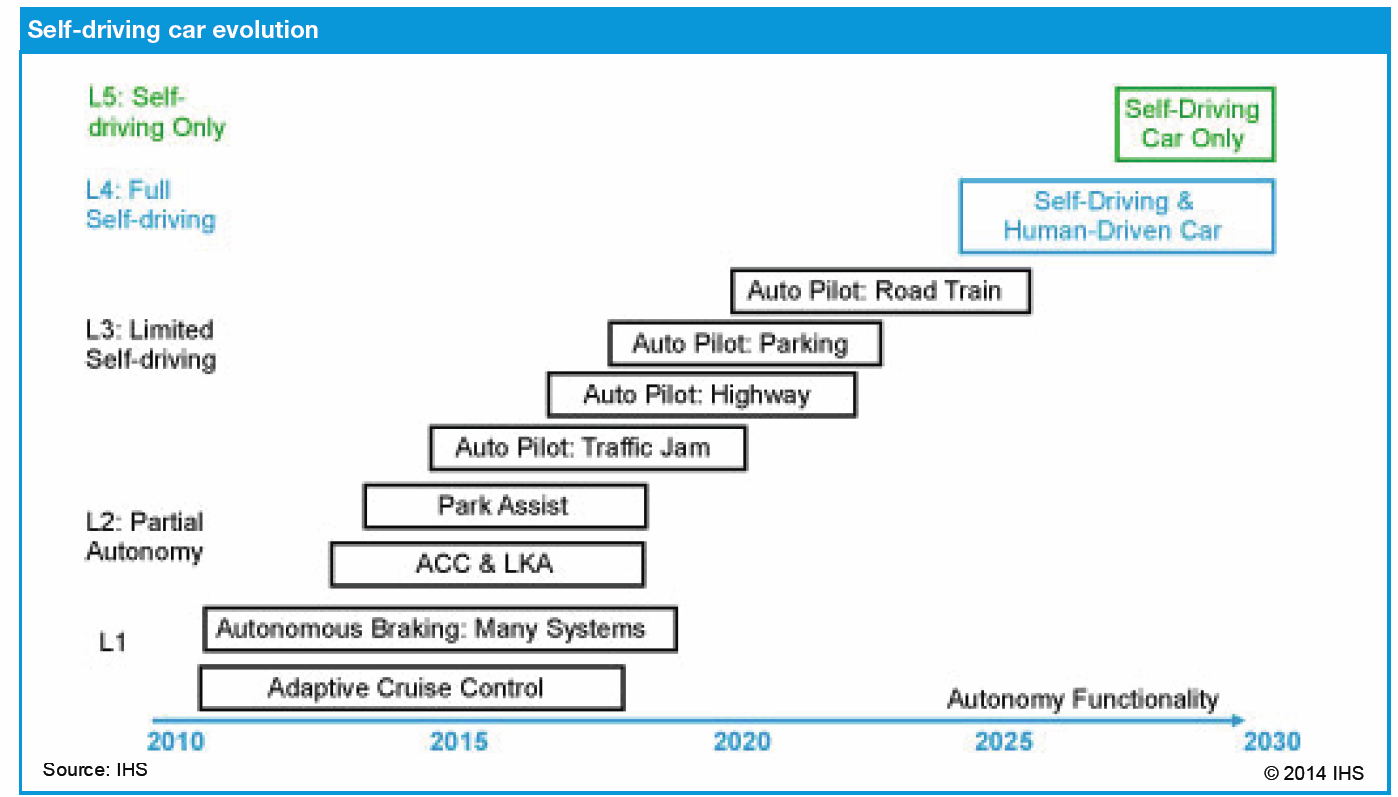
Self-driving cars (SDC) that include driver control are expected to hit highways around the globe before 2025 and self-driving “only” cars (only the car drives) are anticipated around 2030, according to an emerging technologies study on Autonomous Cars from IHS Automotive.
In the study, “Emerging Technologies: Autonomous Cars — Not If, But When,” IHS Automotive forecasts total worldwide sales of self-driving cars will grow from nearly 230 thousand in 2025 to 11.8 million in 2035 — 7 million SDCs with both driver control and autonomous control and 4.8 million that have only autonomous control.
In all, there should be nearly 54 million self-driving cars in use globally by 2035.
The study anticipates that nearly all of the vehicles in use are likely to be self-driving cars or self-driving commercial vehicles sometime after 2050.
The price premium for the SDC electronics technology will add between $7,000 and $10,000 to a car’s sticker price in 2025, a figure that will drop to around $5,000 in 2030 and about $3,000 in 2035 when no driver controls are available.
Benefits of self-driving cars
“There are several benefits from self-driving cars to society, drivers and pedestrians,” says Egil Juliussen, principal analyst for infotainment and autonomous driver assisted systems at IHS Automotive. Juliussen co-authored the study with IHS Automotive senior ADAS analyst Jeremy Carlson.
“Accident rates will plunge to near zero for SDCs, although other cars will crash into SDCs; but as the market share of SDCs on the highway grows, overall accident rates will decline steadily,” Juliussen says. “Traffic congestion and air pollution per car should also decline because SDCs can be programmed to be more efficient in their driving patterns.”
The study also notes some potential barriers to SDC deployment and two major technology risks: software reliability and cyber security. The barriers include implementation of a legal framework for self-driving cars and establishment of government rules and regulations.
Autonomous cars by 2020
[+]
Several automakers have said publicly they will have autonomous cars by 2020, or earlier. Autonomous car technology is already affecting driver assist systems such as adaptive cruise control, lane keep assist, and collision mitigating brake systems.
Additionally, the IHS study says the first group of autonomous cars will have so-called Level 3 capability — limited self-driving that enables the driver to cede full control of all safety-critical functions under certain traffic and environmental conditions and includes auto pilot for highway travel and parking.
Coming later in the decade will be SDCs with Level 4 capability — self-driving but with human controls.
North America is forecasted to account for 29 percent of worldwide sales of self-driving cars with human controls (level 4) and self-driving only cars (level 5) in 2035, or nearly 3.5 million vehicles. China will capture the second largest share at 24 percent, or more than 2.8 million units, while Western Europe will account for 20 percent of the total, 2.4 million vehicles.

References:

  • IHS Automotive, Emerging Technologies: Autonomous Cars - Not If, But When, 2014


(¯`*• Global Source and/or more resources at http://goo.gl/zvSV7 │ www.Future-Observatory.blogspot.com and on LinkeIn Group's "Becoming Aware of the Futures" at http://goo.gl/8qKBbK │ @SciCzar │ Point of Contact: www.linkedin.com/in/AndresAgostini

Thursday, January 2, 2014

Google’s Ray Kurzweil predicts how the world will change


Ray Kurzweil is sitting in an office in San Francisco’s tallest building overlooking the Golden Gate Bridge. Over 45 minutes, speaking rapidly in monotone sentences dense with facts and ideas, Google’s director of engineering has outlined a future for the world that would seem incredible, were it not that this man has a 30-year track record of making seemingly bonkers predictions that have proved to be accurate. Among other things, Kurzweil predicted that the internet would become central to our lives when it was still a niche and unreliable network in the Eighties; he pinpointed when computers would be able to beat humans at chess, eight years before the world champion Garry Kasparov was defeated by IBM’s Deep Blue; and he foresaw the collapse of the Soviet Union.

Kurzweil doesn’t just foretell the future, though — he is also responsible for helping to shape it. A maverick thinker who grew up in Queens, New York, the son of a Jewish conductor and artist, he wrote his first computer program in 1963 aged 15, went on to study at the Massachusetts Institute of Technology and was later inducted into the National Inventors Hall of Fame, having created the world’s first flatbed image scanner, the first music synthesizer capable of re-creating orchestral instruments, and the world’s first print-to-speech reading machine for the blind (the first of which was bought by Stevie Wonder, beginning an enduring friendship between the two men).
One of his current projects is the Google Brain. Working with a young generation of artificial intelligence wizards, he confidently predicts that by 2029 the company will have successfully created a computer system capable of understanding natural language and human emotion. “Right now a kid in Africa with a smartphone can access all of human knowledge, something that the President of the United States could not do even 16 years ago,” he says. “And that sort of rapid progress is only going to continue exponentially.”
Larry Page, Google’s CEO, has also got Kurzweil moonlighting on another of his little pet projects — “solving death”. He is an adviser at the company’s ambitious new Calico venture, which aims to find a cure for ageing. The solution can’t come quickly enough for the 65-year-old, who is personally pursuing immortality. A man who is so excited by the possibilities of life that he never wants it to end, he takes 150 vitamins a day with the aim of extending his life until technology has reached a point that we can implant nanobots in our bodies to back up our immune systems. And after that? “We’ll get to a point where we can actually back up our brains to the cloud,” he says “We routinely back up our phones and notebook computers, but we don’t yet back up the most important information we have, which is our memories and skills, our personality.”
Sounds bonkers? Well, just wait until you read what else he thinks is around the corner . . .
2017: Self-driving cars
“Google self-driving cars have gone half a million miles without human drivers on highways and city streets, with no incidents. Within ten years they will be ubiquitous. Humans have a fairly narrow field of view, these cars have sensors, both visual and laser, and artificial intelligence to be able to assess what’s going on in their environment. Ultimately these cars will communicate with each other and co-ordinate their movements. You also won’t need to own a car, there’ll be a pool of them circulating, and you’ll just call one from your phone when you need it.”
2018: Personal assistant search engines 
“Right now, search is based mostly on looking for key words. What I’m working on is creating a search engine that understands the meaning of these billion of documents. It will be more like a human assistant that you can talk things over with, that you can express complicated, even personal concerns to. If you’re wearing something like Google Glass, it could annotate reality; it could even listen in to a conversation, giving helpful hints. It might suggest an anecdote that would fit into your conversation in real time.”
2020: Switch off our fat cells
“It was in our interest a thousand years ago to store every calorie. There were no refrigerators, so you stored them in the fat cells of your body, which now means we have an epidemic of obesity and type 2 diabetes. Thanks to the Human Genome Project, medicine is now information technology, and we’re learning how to reprogram this outdated software of our bodies exponentially. In animals with diabetes, scientists have now successfully turned off the fat insulin receptor gene. So these animals ate ravenously, remained slim, didn’t get diabetes, and lived 20 per cent longer. I would say that this will be a human intervention in five to ten years, and we will have the means of really controlling our weight independent of our eating.”
2020: Click and print designer clothes at home
“Currently there is a lot of overenthusiasm about 3-D printing. Typically where people are prematurely very excited it leads to disillusionment and a bust, like the dot.com crash. I think we’re about five years away from the really important applications. By the early 2020s we’ll be replacing a significant part of manufacturing with 3-D printing. We’ll be able to print out clothing and there’ll be an open source market of free designs. There will be personal 3-D printers, but also shared ones in your local Starbucks, for example.”
2023: Full-immersion virtual realities
“Computer games have pioneered virtual reality, and within ten years — but probably more like five — these will be totally convincing, full-immersion virtual realities, at least for the visual and auditory senses, and there will be some simulation of the tactile sense. To fully master the tactile sense we have to actually tap into the nervous system. That will be a scenario within 20 years. We’ll be able to send little devices, nanobots, into the brain and capillaries, and they’ll provide additional sensory signals, as if they were coming from your real senses. You could for example get together with a friend, even though you were hundreds of thousands of miles apart, and take a virtual walk on a virtual Mediterranean beach and hold their hand and feel the warm spray of the moist air in your face.”
2030: Vertical meat and vegetable farms
“There will be a new vertical agriculture revolution, because right now we use up a third of the usable land of the world to produce food, which is very inefficient. Instead we will grow food in a computerised vertical factory building (which is a more efficient use of real estate) controlled by artificial intelligence, which recycles all of the nutrients so there’s no environmental impact at all. This would include hydroponic plants, fruits and vegetables, and in vitro cloning of meat. This could also be very healthy — we could have meat with Omega-3 fats instead of saturated fats, this sort of thing.”
2033: 100 per cent of our energy from solar
We are applying new nanotechnologies to the design of solar panels, and the costs are coming down dramatically. A recent report by Deutsche Bank said that ‘the cost of unsubsidised solar power is about the same as the cost of electricity from the grid in India and Italy. By 2014 even more countries will achieve solar grid parity’. So I do believe that within 20 years we could get all our energy from solar energy. I presented this not so long ago to the Prime Minister of Israel, Benjamin Netanyahu, who was actually my classmate at MIT’s Sloan School of Management, and he said: “Ray, do we have enough sunlight to do this with?” and I said: “Yes, we’ve got 10,000 times more than we need.”
2040: Stay young for ever 
“Twenty years from now, we will be adding more time than is going by to your remaining life expectancy. We’ve quadrupled life expectancy in the past 1,000 years and doubled it in the past 200 years. We’re now able to reprogram health and medicine as software, and so that pace is only going to continue to accelerate. There are three bridges to life extension. Bridge 1 is taking aggressive steps to stay healthy today, with today’s knowledge. The goal is to get to bridge 2: the biotechnology revolution, where we can reprogram biology away from disease. Bridge 3 is the nanotechnology revolution. The quintessential application of that is nanobots — little robots in the bloodstream that augment your immune system. We can create an immune system that recognises all disease, and could be reprogrammed to deal with new pathogens.”
The future of travel
Dominic Harrison, director of global trends at Future Foundation
Climate-change tourism 
People already travel to places such as Cuba to go and see a Communist state before Castro dies, and there are tours to North Korea. What we expect to start seeing is travel to places such as the Amazon rainforest for a last peek at the wonders of nature, or the Alps to check out the glaciers for the last time. Disappearing planet — see it before it goes.
Try before you buy
We are increasingly planning holidays meticulously before we leave, and we term this “the end of adventure”. There are apps such as Hyperlapse on Google Street View, or Shnergle, which allows individuals to “check out a place you’re interested in visiting in near real time to help you decide if you want to go”.
Future of food
Dr Morgaine Gaye, food futurologist
Condiment explosion 
The range, variety and provenance of condiments is going to develop hugely next year. They will even become foods in their own right. Vinegar is set to become the non-alcoholic drink of choice, in hedgerow flavours with an artisan twist. On the back of the popularity of wasabi, mustard varieties are going to gain complexity and nuance, and will become a commonplace flavouring in a wider variety of unlikely foods and desserts.
Michelin-starred insects
Currently a fun food fad, insects will become mainstream in about 2016, firstly being used discreetly to create other foods, such as meat sauces, nut replacements and burgers or sausages. Mini-livestock (insects) are already becoming more popular as countries begin to embrace the possibilities of entomophagy, most notably the Netherlands, where it has been pioneered by Wageningen University, which started promoting insects as food in the 1990s.
Future of fashion
Suzanne Lee, fashion futurologist and founder of BioCouture
Digital fashion
Laboratories such as London’s Studio XO are creating extraordinary outfits for the likes of Lady Gaga and driving tech into the fashion mainstream. Their digital mermaid bra for Azealia Banks was studded with hundreds of Swarovski crystals and LEDs, which diffracted light, animating the crystals in time to the music. Other fashion tech labels, including CuteCircuit, sell LED T-shirt dresses that react to the wearer’s movement, others receive and display tweets in real time. Expect your clutch purse to be Facebooking soon.
Grow your own clothes 
We are beginning to get living organisms like mammalian cells, bacteria, fungi and algae to grow materials for us. At my company Biocouture we are busy growing material from bacteria for a skirt that will be exhibited in Selfridge’s next month. Modern Meadow, a spin-off of a US-based tissue engineering company, is aiming to produce cultured leather handbags by 2015.
British cultural trends
Lucie Greene, LS:N Global editor
Rise of the Amortals 
Our population is ageing, but far from being a burden on the economy, Sarah Harper at the Oxford Institute of Ageing believes that the age of retirement is becoming meaningless, because people have to work much longer. This later stage in life will become the exciting third age, and it will transform the way we think about our careers and plan our families.
Slash-slash career paths 
Traditional career paths aren’t open to millennials so they’re making money using things such as Airbnb, eBay, or the new websites StyleOwner and Nuji, which allow you to create your own virtual shopfront of your favourite things, like Pinterest, and if anything is sold you get a payment. They can rent out their rooms, and market their taste.
THE TIMES


(¯`*• Global Source and/or more resources at http://goo.gl/zvSV7 │ www.Future-Observatory.blogspot.com and on LinkeIn Group's "Becoming Aware of the Futures" at http://goo.gl/8qKBbK │ @SciCzar │ Point of Contact: www.linkedin.com/in/AndresAgostini
Vitamin E may delay decline in mild-to-moderate Alzheimer’s Disease, study finds. At http://www.kurzweilai.net/vitamin-e-may-delay-decline-in-mild-to-moderate-alzheimers-disease-study-finds


(¯`*• Global Source and/or more resources at http://goo.gl/zvSV7 │ www.Future-Observatory.blogspot.com and on LinkeIn Group's "Becoming Aware of the Futures" at http://goo.gl/8qKBbK │ @SciCzar │ Point of Contact: www.linkedin.com/in/AndresAgostini
Vapor nanobubbles rapidly detect malaria through the skin. At http://www.kurzweilai.net/vapor-nanobubbles-rapidly-detect-malaria-through-the-skin


(¯`*• Global Source and/or more resources at http://goo.gl/zvSV7 │ www.Future-Observatory.blogspot.com and on LinkeIn Group's "Becoming Aware of the Futures" at http://goo.gl/8qKBbK │ @SciCzar │ Point of Contact: www.linkedin.com/in/AndresAgostini
Ultrathin ‘diagnostic skin’ allows continuous patient monitoring. At http://www.kurzweilai.net/ultrathin-diagnostic-skin-allows-continuous-patient-monitoring


(¯`*• Global Source and/or more resources at http://goo.gl/zvSV7 │ www.Future-Observatory.blogspot.com and on LinkeIn Group's "Becoming Aware of the Futures" at http://goo.gl/8qKBbK │ @SciCzar │ Point of Contact: www.linkedin.com/in/AndresAgostini

Hubble sees cloudy ‘super-Earth’ 40 light-years away. At http://www.kurzweilai.net/hubble-sees-cloudy-super-earth-40-light-years-away

(¯`*• Global Source and/or more resources at http://goo.gl/zvSV7 │ www.Future-Observatory.blogspot.com and on LinkeIn Group's "Becoming Aware of the Futures" at http://goo.gl/8qKBbK │ @SciCzar │ Point of Contact: www.linkedin.com/in/AndresAgostini

The NSA is Building the Foundation for a Global Police State. At http://www.globalresearch.ca/the-nsa-is-building-the-foundation-for-a-global-police-state/5363186#!

(¯`*• Global Source and/or more resources at http://goo.gl/zvSV7 │ www.Future-Observatory.blogspot.com and on LinkeIn Group's "Becoming Aware of the Futures" at http://goo.gl/8qKBbK │ @SciCzar │ Point of Contact: www.linkedin.com/in/AndresAgostini